Illyana Yates
Nosferatu
F.W. Murnau
1920
One thing I always can never let go of is knowing the intention of an artistic creator. What exactly was Murnau thinking when directing Nosferatu, was he thinking of Count Orlok as a coded representation of himself or a reclamation of queer identity in the role of monster, was there a clear intention to relay this to the audience? Even though I know there are plenty of wonderful reasons that artistic intention isn’t always necessary, sometimes I can’t get over the anxiety of the unknown. Benshoff’s idea that film can be queered did quench my need for answers in a way I’ve thought about before but couldn’t always fully envision – some films, especially horror through the use of the monster, are
queered by the audience’s perception and interpretation of them through their, “active queer (or gay, or lesbian) reading practices” (99). This indicates that, because of the sweeping marginalization of homosexual identities there is a universal queer understanding and reading that individual members in the community gather from popular culture media that then becomes part of the iconographic indications of queer identities, such as the vampire. The invisibility of this queer identity is essential for it to exist in popular culture but is incredibly visible to those who share that identity. This becomes a two-way street, the dominant culture that demands heterosexual as the norm creates the homosexual as villainous, which makes it possible for queer identities to be hidden in plain sight in popular culture through a reclamation of the monster as a queer icon, which may reinforce the ideas of the dominant group but also act as way to resist a heterosexual norm.
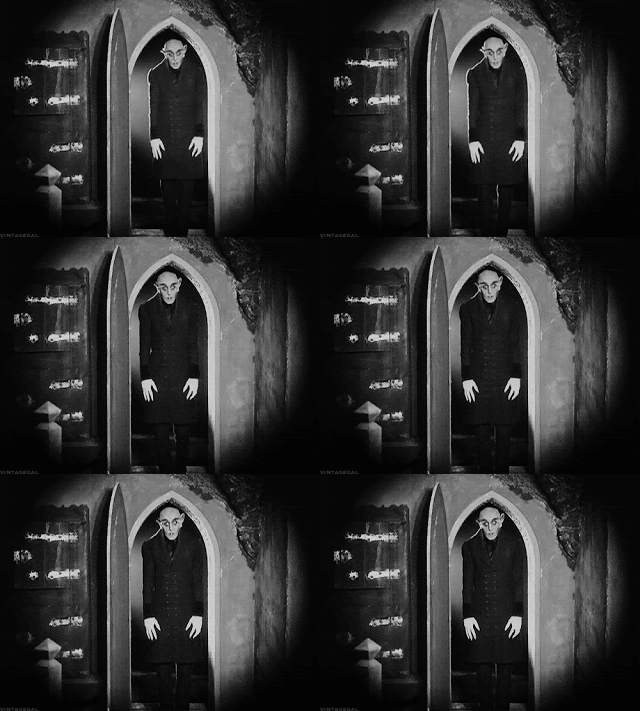
In Nosferatu, Count Orlok can be read as queer, his stature and clothing, his relation to Hutter and Renfield, and probably to American audience in the 20’s his overt European-ness. The specific scene that stuck out to me that Orlok is directly shown as being romantically homosexual is through the suturing onto a heterosexual relationship is the famous scene where he’s in the door.
Here the scene cuts from Orlok about to drink Hutter’s blood to Ellen connecting with her husband to warn him. This quick cut between the two sharing a bond with Hutter, accompanied by the music which is dream-like and light - what you’d expect between Ellen and Hutter – for both the monster and the hetero-woman. This felt like a clear mapping of Orlok into a homosexual relationship. In the end our sort of pre-final girl hero is Ellen, sacrificing herself to Orlok in order to safe everyone else. This puts an innocent heterosexual woman as the ultimate hero vanquishing the demon that brought a plague to the town and ultimately saving all the men we were introduced to in the film. The heterosexual couple wins but they also loose big time, Ellen dies just the same as Orlok.
Very vaguely on Wikipedia it says that Murnau was influenced by Schopenhauer, I don’t know a lot about his philosophy, but I know he talks about the will to live determined by the need to reproduce and that’s why people fall in love. Which for a homosexual man doesn’t seem great, but Schopenhauer also hates that this is why people continue living and wants everyone to dive into the arts in order to keep our minds off of it and actually be good people and not just horny all the time. I think his theory insinuates that there is an inherent fear in people regarding sex and death that Benshoff also talks about with queer relationships valuing death because of non-procreative sex (94). I think Murnau recognizes this (he does dedicate his life to art) and displays the anxiety of death through deviant sexual desires in Orlok’s queer reading and the death he brings upon the ship and dismantling a heterosexual relationship.
There is a capitalization on the fear of queer sexual desires leading to death that is deemed ‘unnatural’ because it doesn’t allow for reproduction. Queer identities become the enemy because they undermine the hierarchy structure of the dominant group, the inclusion of, “race, gender, disability, and class addressed within its politics … linking the queer corpus with the figure of the Other,” dismantles a power structure fixed in our political and social worlds (94). The repression of identities and the creation of an enemy is essential to uphold this, like with the grime-houses existence benefiting nicer theaters because the juxtaposition allows them to be even better and cleaner than the alternative. Count Orlok is the monster because the heterosexual couple needs adversary to prove their strength over the enemy, but Murnau doesn’t let this happen completely, we focus more on the cool creepy vampire than any other character and at the end of the day the straight couple doesn’t even really win.