Illyana Yates
It’s very understandable why I’ve had to watch this film so many times for various classes, there is always just so much to unpack and it never seems to get old. This time around I was focusing on very different ideas than from the musicology classes I’ve watched it in, although some of it does relate. The opening credits that feature Wendy Carlo’s piece that sets the uncanny tone for the entire movie, the rolling trills and screams sound human but are so distinctly artificial. This matched up with the use of the steady cam long shot put the audience into the uncanny, unsettling world that the Overlook exists in. It also positions the audience as an over looker themselves watching the family’s car drive through the
The Shining
Stanley Kubrick
1980
Men, Women, Chainsaws: Gender in the Modern Horror Film
Carol J. Clover
Introduction: Carrie and the Boys (3-20)
Her Body, Himself (21-64)
mountains, bringing into question who is watching them? This shot clearly isn’t human, but it isn’t definitively not either, somewhere in-between. The music and other sounds seep in through-out the film marking moments where other forces are at work, the other force being the hotel itself and the history of the hotel personified or rather monster-ized. If we think about Carol Clover’s analysis of the slasher film, there are a lot of similarities and I think meaningful divergences from the typical conventions of a slasher film.
The killer is obviously Jack however, he introjects the villainy of the hotel primed by his previous violent act with Danny and the hotel is able to take over because of the shaky foundation of the family. Jack isn’t able to be the patriarch of the family that lays down the law to his son Danny because of his previous overstepping of that boundary. This gives Wendy (who is androgynous juxtaposed against the woman in the tub that entices the sexually frustrated Jack) the ultimate control in the role of taking care of Danny which for Jack becomes his biggest issue and downfall.
It’s interesting because Jack becomes non-human with his monstrous actions and unusual behavior at the same time when the hotel is humanized as a force that watches over the family and penetrates Jacks psyche (another form of de-masculinization).
The hotel acts as the Terrible Place, the expansive maze-like quality of the hotel is a confusing repetitious place that seem to fold in on itself as though it is never ending. This idea of cyclical never ending liminality is an important theme of the film, not only is it physically this way but also in the sense of time. The past of the hotel seeps into the present, a palimpsest of evil. The actual maze is a place that Wendy and Danny have mastered, a feminine space (dark, dank, internal) that in the end castrates Jack.
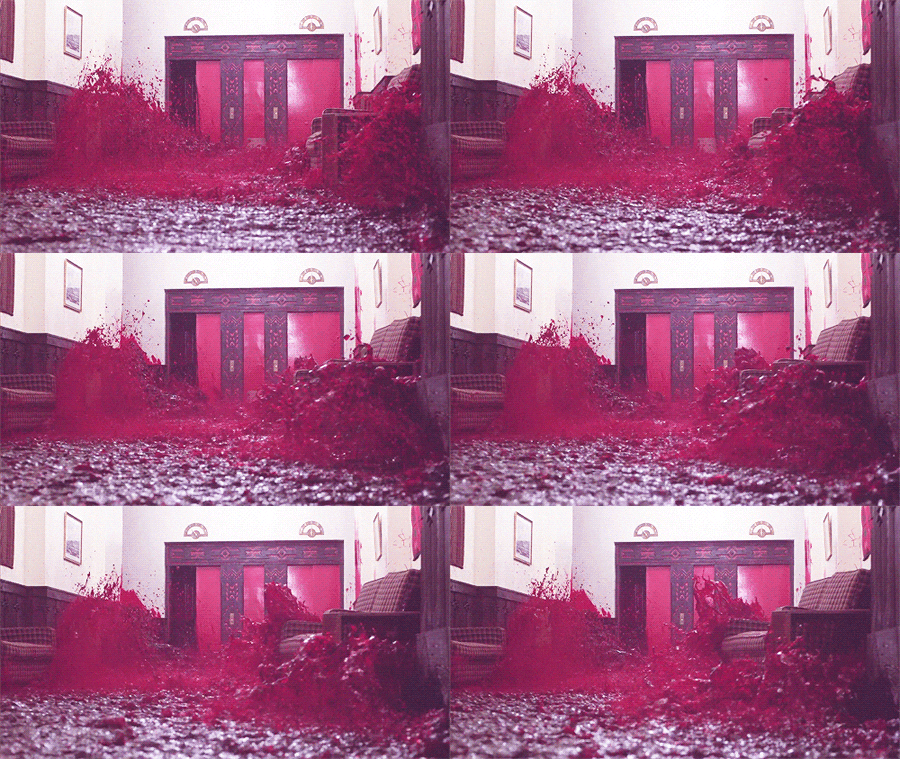
Another way in which Jack is a part of the past is when he wields the axe as his weapon of choice. It is an archaic, pretechnological weapon that emphasizes the influence of the past on him, and also is a lot more brutal and terrifying. The pretechnological and influence of the past is also demonstrated in the idea that the hotel was built on an old Native burial ground and therefore might explain the supernatural elements. One scene in particular that I think stands out as showing the violence in tandem with the hotel as an imperialistic monument is the famous scene where blood rushes out of the elevator.
It is extremely unsettling but so abjected from a physical body that it doesn’t seem to have that gross factor that is found in slasher films. I think the blood is to indicate the blood spilled at the hotel, including the Natives buried underneath, and the distancing from a human form, or the humanizing of the hotel, speaks to the dehumanizing of the victims that were killed here.
The victims in the narrative of the movie are Wendy and Danny (and Halloran) who are evading Jacks unruly swinging of his axe. However, as Clover says, “the threat function and the victim function coexist in the same unconscious,” Wendy and Danny become the hero’s by defeating Jack (47). Jack is also kind of a victim because he’s overcome by the spirit of the hotel and consumed into this lineage of murders that each have their own villains/victims. The idea of a lineage is dependent on the bloodline of the father and while this lineage follows the men like Grady, it is also a monstrous non-familial bloodline that is warped because of the feminizing of the family and the patriarchy attempting the take it over again.
Like Clover says with Psycho this film, “suggests so much but shows so little,” although with The Shining there is an overwhelming amount shown but not really graphic or that tells the audience exactly what is happening (41). The biggest fear is of the unknown and there is so much unknown in this film, hence why there is an abundance of theories on all the hidden meanings that Kubrick put into the film. I think that is one of the most interesting aspects of this film is that the audience is given so much visual information in a world that is so ambiguous and fluid which has led to this being such a fan favorite to dive into and find deeper meaning in. I wonder what this film is responding to in the values of the late ‘70’s and being in the middle of the slasher film run? The abundance of interpretations separates this film from slasher films that purposely have a formula, while there does exist a basic formula in the narration there also seems to be so much more lying underneath that excites audiences.